你的 AI 账单,
逐项拆解
已支持 36 款工具,仍在增加


菜单栏应用
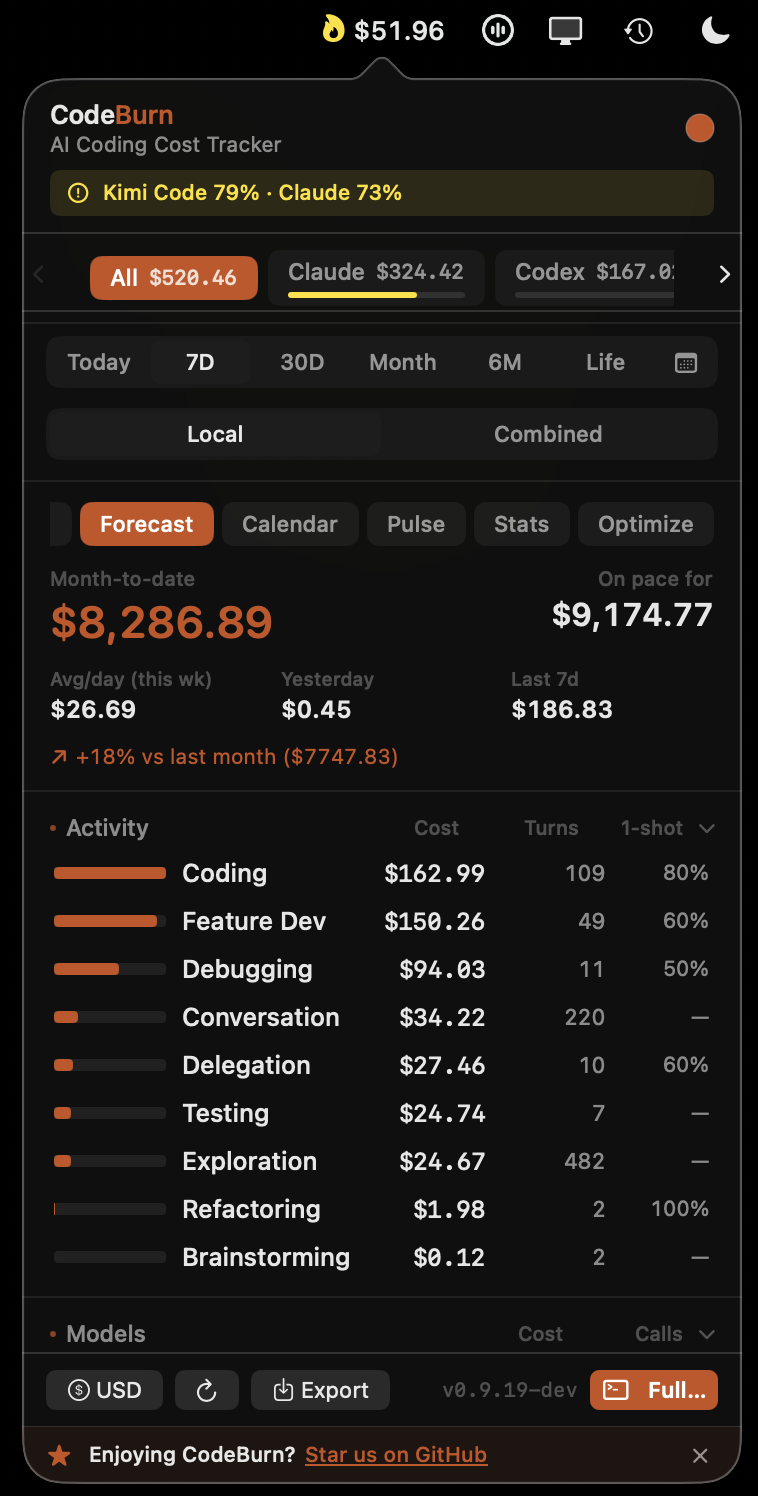
过去你要到月底才知道。现在这个数字整天就待在时钟旁边,浮在每个窗口之上,点一下就展开完整账单。
当天开销就在时钟旁边。无需打开面板,也不用翻标签页。
实时计量每个智能体的套餐用量,并显示各时间窗口的剩余时间。
按智能体统计从今天到全部历史的用量,可查看单机数据或跨设备合并。
按活动拆分开销:写代码、调试、做功能,并附带轮次和一次命中率。
原生 Swift 编写。仅读取本地会话文件,任何数据都不会离开你的 Mac。在 Linux 上,同样的数字会显示在 GNOME 顶栏。
桌面应用
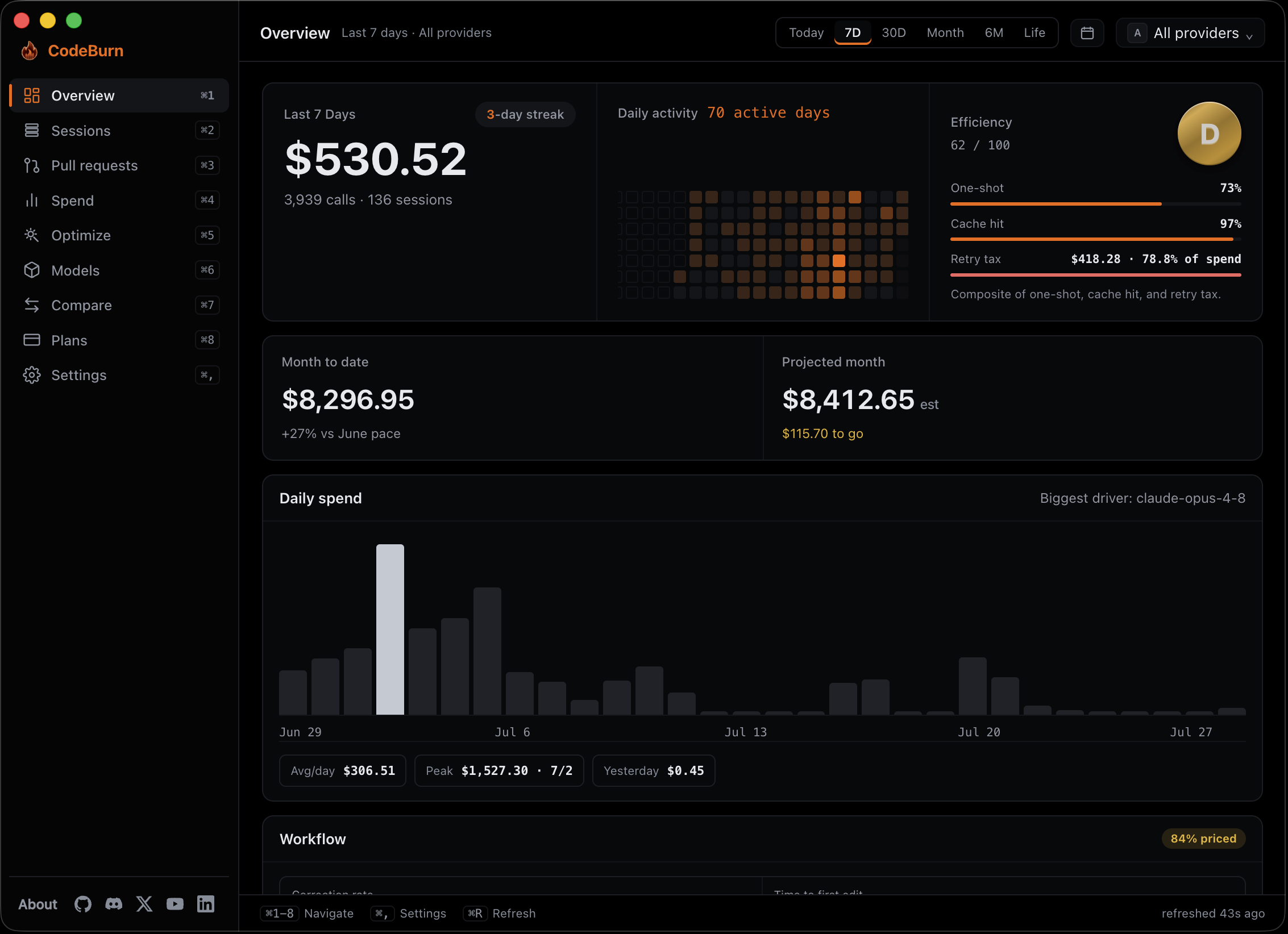
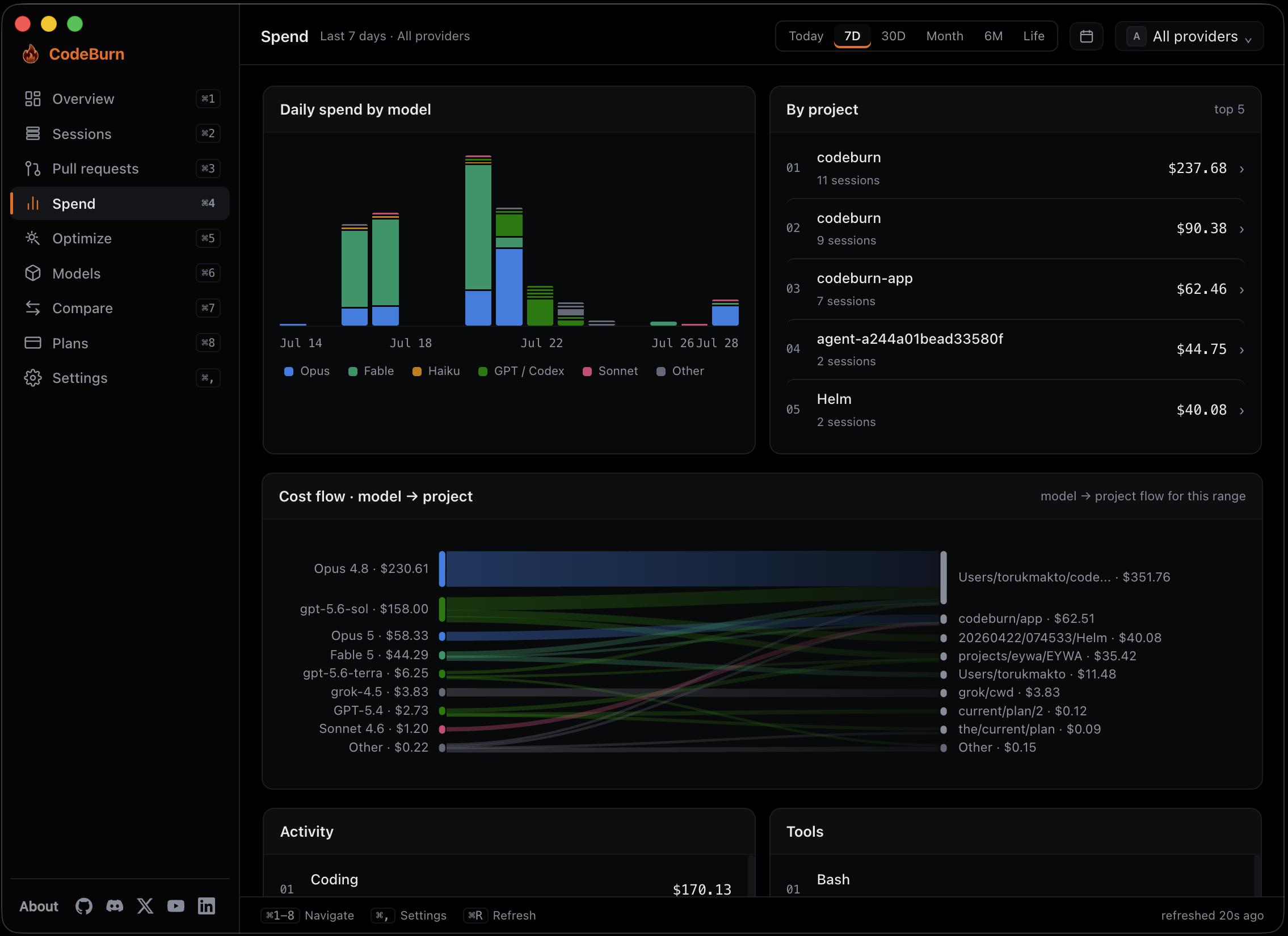
账单不再是一个数字,而是一张地图:哪个模型、哪个项目、哪次会话,以及你付钱换来的工作是否留了下来。
成本流向图展示任意时间范围内,哪个模型把钱花在了哪个仓库。
由一次命中率、缓存命中和重试损耗共同构成的效率评分。
预测本月总额,并将你的节奏与上月对比。
把开销归因到这些工作真正产出的分支和 PR 上。
免费开源。支持 macOS、Windows 和 Linux。
终端
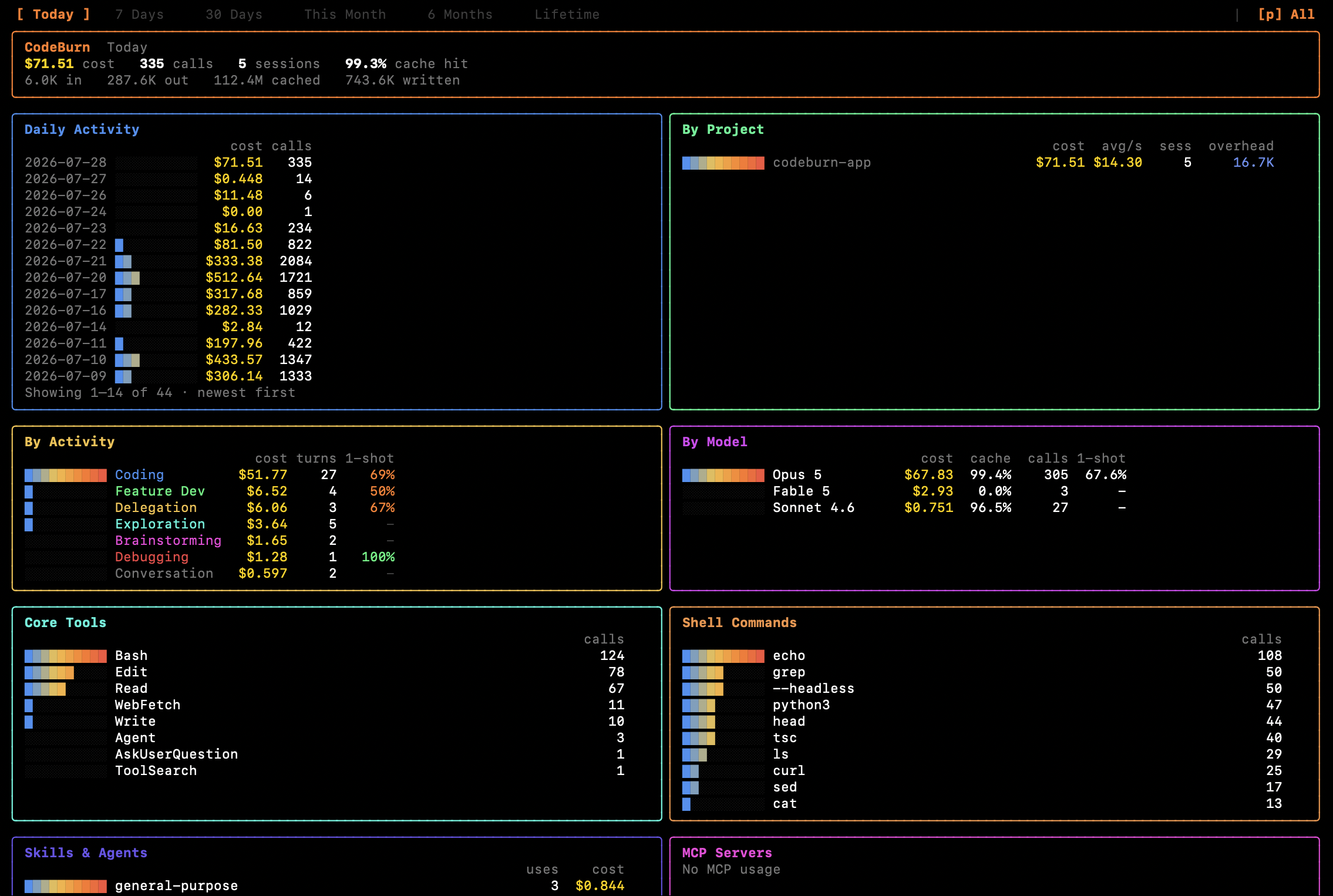
运行 npx codeburn,完整视图就在你已经身处的地方展开。无需安装、无需账号、无需配置。
在今天、一周、一月、半年或全部运行记录之间切换整个视图。
项目、模型、活动、核心工具、Shell 命令、Skills 与智能体,同时呈现。
缓存命中率、轮次和一次命中率就在每笔成本旁边,不必另开报表。
统计你的运行所调用的 MCP 服务器、Skills 和委派智能体的用量与成本。
同样支持 Homebrew。与菜单栏和桌面应用读取的是同一份汇总数据。
从 GitHub 到 Hacker News,开发者都在讨论 CodeBurn。
THIS TOOL SHOWS YOU EXACTLY WHERE YOUR CLAUDE CODE TOKENS ARE GOING. This guy was spending $200+ a day on Claude Code with zero visibility into what was eating the tokens. So he built a terminal dashboard that reads your session transcripts and classifies every single turn.
“This is actually pretty useful. Most people have no idea how much they're spending on AI tools until it adds up, so having it visible in the menubar makes a lot of sense. Really solid idea though, especially being open source.”
“Wait this is so sick! Definitely adding this when I get home”
“big thanks! needed this so badly.”
“Thank you - very interesting. I will try it out.”
“Beautiful”
“We definitely need to install this before our Polymarket scripts bankrupt us on API calls”
“CodeBurn Is The Latest Usage Tracker Blowing up On Github. 435 likes, 16K+ views.”
“You may want to bookmark this!! Do you know the true dollar cost of every Claude Code session?”
“Thanks for the quick turnaround and for getting the invariants right. The reconciliation guarantee is what makes this safe to consume.”
THIS TOOL SHOWS YOU EXACTLY WHERE YOUR CLAUDE CODE TOKENS ARE GOING. This guy was spending $200+ a day on Claude Code with zero visibility into what was eating the tokens. So he built a terminal dashboard that reads your session transcripts and classifies every single turn.
“This is actually pretty useful. Most people have no idea how much they're spending on AI tools until it adds up, so having it visible in the menubar makes a lot of sense. Really solid idea though, especially being open source.”
“Wait this is so sick! Definitely adding this when I get home”
“big thanks! needed this so badly.”
“Thank you - very interesting. I will try it out.”
“Beautiful”
“We definitely need to install this before our Polymarket scripts bankrupt us on API calls”
“CodeBurn Is The Latest Usage Tracker Blowing up On Github. 435 likes, 16K+ views.”
“You may want to bookmark this!! Do you know the true dollar cost of every Claude Code session?”
“Thanks for the quick turnaround and for getting the invariants right. The reconciliation guarantee is what makes this safe to consume.”
A handy little tool I discovered, specifically designed to keep tabs on the token bills for Claude Code and Codex. When you usually use AI to write code, where the tokens are spent, which model burns through money the fastest.
“Very nice. Feels like one of those tools that becomes obvious the moment you see your spend broken down this clearly. Looks like the project has great velocity now.”
“I'd love something like this Claude Desktop. Looks great.”
“Been using this a lot since I discovered it a few weeks ago. Thanks for building and sharing!”
“Looks like it may be useful, thank you”
“Looks cool! Is it able to track stats for models that I use through a non-opencode subscription? Like if I use gpt-5.3-codex through a chatgpt subscription in opencode, will I be able to see some usage stats for it?”
“This is a game changer for anyone trying to scale their agentic workflows without going broke. Visualizing where the tokens actually go makes it much easier to optimize your development budget.”
“CodeBurn, an open-source dashboard built by the AgentSeal team that answers the one question every developer using Claude Code or Cursor is frustrated about: where the hell did all my tokens go?”
“ah nice, you are doing some amazing work. Just to let you know — Visa has forked CodeBurn internally and suggested employees try it.”
“Thanks for shipping this so quickly. Two choices are nicer than what I proposed. NSStatusItem.variableLength is a cleaner answer, and Int((cost * rate).rounded()) rounds correctly where my version would silently truncate.”
A handy little tool I discovered, specifically designed to keep tabs on the token bills for Claude Code and Codex. When you usually use AI to write code, where the tokens are spent, which model burns through money the fastest.
“Very nice. Feels like one of those tools that becomes obvious the moment you see your spend broken down this clearly. Looks like the project has great velocity now.”
“I'd love something like this Claude Desktop. Looks great.”
“Been using this a lot since I discovered it a few weeks ago. Thanks for building and sharing!”
“Looks like it may be useful, thank you”
“Looks cool! Is it able to track stats for models that I use through a non-opencode subscription? Like if I use gpt-5.3-codex through a chatgpt subscription in opencode, will I be able to see some usage stats for it?”
“This is a game changer for anyone trying to scale their agentic workflows without going broke. Visualizing where the tokens actually go makes it much easier to optimize your development budget.”
“CodeBurn, an open-source dashboard built by the AgentSeal team that answers the one question every developer using Claude Code or Cursor is frustrated about: where the hell did all my tokens go?”
“ah nice, you are doing some amazing work. Just to let you know — Visa has forked CodeBurn internally and suggested employees try it.”
“Thanks for shipping this so quickly. Two choices are nicer than what I proposed. NSStatusItem.variableLength is a cleaner answer, and Int((cost * rate).rounded()) rounds correctly where my version would silently truncate.”
Someone was spending $200+ a day on Claude Code with no idea where the tokens were going. So they built a terminal dashboard that classifies every session turn into 13 categories. More than half the money was going to conversation, not code. One line install: npx codeburn.
“Great to see someone actually evaluating, sharing data and insights over the hundreds of "this sucks" posts with zero context. Thanks!”
“Thanks for the context. Quality post.”
“That is cool. Will try it out soon.”
“Interesting! I like it!”
“wait this is actually useful. was literally wondering yesterday why my claude bill was so high when i wasn't coding that much. gonna try this today”
“Visibility is key.”
“Very useful”
“Great tool. Installed via npx, zero friction, immediately useful on a 15-project setup running 170+ sessions/month across Opus and Sonnet. Starred.”
“Confirmed working! Before fix: 0 Gemini sessions detected. After fix: 54 sessions captured, full breakdown intact. Thanks for the fast turnaround on the fix!”
Someone was spending $200+ a day on Claude Code with no idea where the tokens were going. So they built a terminal dashboard that classifies every session turn into 13 categories. More than half the money was going to conversation, not code. One line install: npx codeburn.
“Great to see someone actually evaluating, sharing data and insights over the hundreds of "this sucks" posts with zero context. Thanks!”
“Thanks for the context. Quality post.”
“That is cool. Will try it out soon.”
“Interesting! I like it!”
“wait this is actually useful. was literally wondering yesterday why my claude bill was so high when i wasn't coding that much. gonna try this today”
“Visibility is key.”
“Very useful”
“Great tool. Installed via npx, zero friction, immediately useful on a 15-project setup running 170+ sessions/month across Opus and Sonnet. Starred.”
“Confirmed working! Before fix: 0 Gemini sessions detected. After fix: 54 sessions captured, full breakdown intact. Thanks for the fast turnaround on the fix!”
“Genuinely thank you so much for this. I was able to find where my claude has been opening thousands of terminal sessions and eating up my tokens without me even sending a single message. Super duper helpful”
“Immediate install and use. It's brilliant, thank you OP!”
“I need this in my life”
“Nice design! Good job!”
“Thanks for making this, will try this out with my team!”
“Codex, Claude Code, Cursor... quietly hiding the real cost of your usage. That's why CodeBurn exists. It tracks tokens, cost, and performance across 18+ AI coding tools, so you can compare models, optimize usage, and see where your budget leaks.”
“beautiful”
“Install codeburn, then run codeburn optimize. That command scans your coding agent sessions for specific waste. Repeated file reads, low read-to-edit ratios, uncapped bash output, unused MCP servers. And returns token-level savings estimates per fix.”
“Four out of six in a single release cycle is genuinely impressive. Per-project drill-down and cost-per-session are exactly what I needed most. Great project.”
“And thanks for the quick fixes!!”
“Genuinely thank you so much for this. I was able to find where my claude has been opening thousands of terminal sessions and eating up my tokens without me even sending a single message. Super duper helpful”
“Immediate install and use. It's brilliant, thank you OP!”
“I need this in my life”
“Nice design! Good job!”
“Thanks for making this, will try this out with my team!”
“Codex, Claude Code, Cursor... quietly hiding the real cost of your usage. That's why CodeBurn exists. It tracks tokens, cost, and performance across 18+ AI coding tools, so you can compare models, optimize usage, and see where your budget leaks.”
“beautiful”
“Install codeburn, then run codeburn optimize. That command scans your coding agent sessions for specific waste. Repeated file reads, low read-to-edit ratios, uncapped bash output, unused MCP servers. And returns token-level savings estimates per fix.”
“Four out of six in a single release cycle is genuinely impressive. Per-project drill-down and cost-per-session are exactly what I needed most. Great project.”
“And thanks for the quick fixes!!”